1. Queens: the closest colored-region comparison
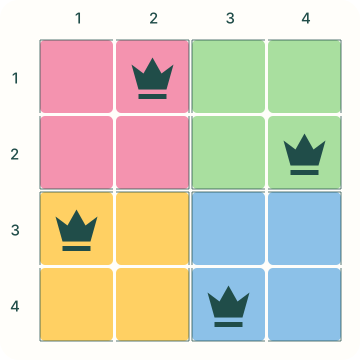
LinkedIn Queens asks for one crown in every row, column and colored region, with no two crowns touching, including diagonally. That makes its core placement rules a close comparison with Meowdoku’s Cats. A confirmed crown can eliminate a row, column, region and immediate neighbors; a region trapped within one line creates the same kind of reasoning opportunity. The diagram uses crowns rather than Cats so the shared structure is easy to see. It is our own small illustration, not a screenshot or a reproduction of a published daily puzzle.
Do not confuse this colored-region game with the classical N-Queens chess problem. In the chess problem a queen attacks along an entire diagonal; in LinkedIn Queens, the diagonal restriction is about adjacent cells. Those are different constraints and produce different legal boards. LinkedIn’s daily schedule, assistance settings and account features belong to that product, not to Meowdoku Web. If you arrive searching for a LinkedIn Queens cat game, the useful connection is the placement logic and click-cycle style, rather than an official relationship between the two sites. Read LinkedIn’s rules before moving between their game and ours.
2. Star Battle: pay attention to the star count
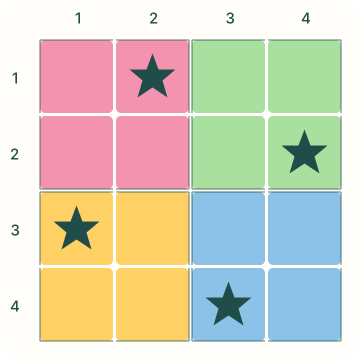
In a one-star Star Battle puzzle, every row, column and region needs exactly one star, and stars cannot touch horizontally, vertically or diagonally. This is another close comparison with Cat placement. The one-star teaching diagram shows how different region shapes still obey one consistent set of constraints. An X-like exclusion mark can be useful, but the exact input controls depend on the version you choose. A star puzzle does not become ordinary Sudoku just because its board is divided into areas.
Many Star Battle puzzles require two stars per row, column and region, or another specified number. Never carry Meowdoku’s one-Cat assumption into those boards. A line with one confirmed star may still need another, and a region with several candidates can have combinations rather than one remaining position. The non-touch rule continues to matter, but the counting argument changes. Check the star count before trying to reuse a strategy. For someone who likes Meowdoku’s regions and wants a different counting challenge, this is a useful next type to explore. The linked provider’s instructions explain the one-star, two-star and other variants; this page does not promise that our Solver accepts those variants.
3. Sudoku: candidates are digits, not Cat positions
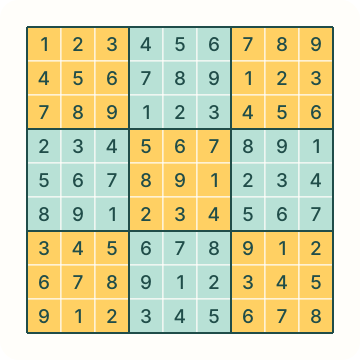
Standard Sudoku fills a 9 × 9 grid with digits 1 through 9. Each row, column and outlined 3 × 3 box must contain all nine digits without repetition. In Meowdoku, you decide whether a cell contains a Cat; in Sudoku, you decide which digit belongs there. Both reward tracking what is ruled out and noticing a single remaining candidate. Their candidate sets are different, so a Cat board cannot simply be read as a numerical Sudoku grid. The sample below shows a valid completed standard pattern, not a Meowdoku answer.
The everyday label Cat Sudoku can help people find Meowdoku, but it should not hide that difference. Standard Sudoku does not normally prohibit equal digits in diagonally adjacent cells unless a particular variant adds such a rule. Its boxes are also usually the regular 3 × 3 ones, while Meowdoku uses colored regions with varied shapes. If you like the discipline of checking a candidate against several units, Sudoku is a natural comparison. Follow the linked Nikoli instructions for the standard rules, and check a variant’s instructions separately. Our Cat Solver is not a general digit-Sudoku solver, so use an appropriate tool if you switch puzzle types.
4. Nonograms: turn line clues into a picture
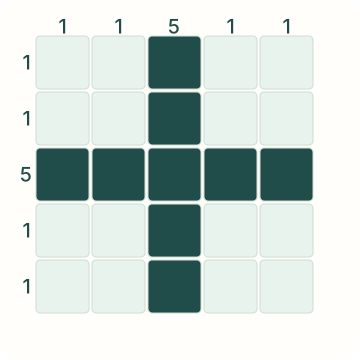
A Nonogram gives ordered numbers beside each row and column. Those numbers describe the lengths of consecutive filled runs, with empty space separating distinct runs. The goal is to decide which cells are filled and which are empty. The cross-shaped example below has consistent row and column clues; it illustrates how checking one line can constrain another. Unlike Meowdoku, a row may contain many filled cells, and there are no colored regions each requiring one piece. Empty-cell marks therefore mean something different from a Cat puzzle’s excluded candidate.
The common habit is to record what you have proved before acting on what merely looks likely. A picture may suggest an outline, but visual recognition should not substitute for checking the clues. Similarly, a familiar Meowdoku region shape is not proof that it has the same answer as a different guide. When trying Nonograms, learn how runs fit within a line and how confirmed filled or empty cells reduce their possible placements. The linked Pattern documentation describes the rules and its version’s controls. Our illustration is an original five-by-five teaching pattern, and the recommendation does not imply that Meowdoku Web contains a playable Nonogram mode.
5. Minesweeper: local counts and careful assumptions
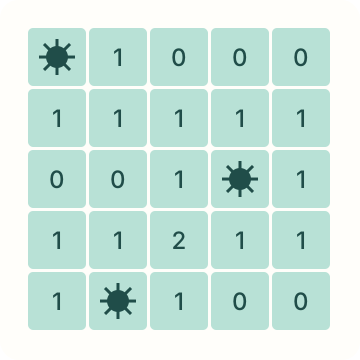
Minesweeper hides mines under covered cells. An uncovered number tells you how many mines occupy its neighboring cells, including diagonals, and the usual goal is to uncover every cell without a mine. That local eight-neighbor relationship may feel familiar after Meowdoku, but the rule is different: mines can be adjacent, and numbers count them rather than prohibit contact. The illustration reveals a small field so you can compare each number with its surrounding mines. It is a teaching diagram, not an embedded playable game.
Flags and exclusion marks are useful only when their reasons are correct. Assuming a flag is certain can corrupt later counting just as an incorrect X can corrupt Cat candidates. Some Minesweeper boards or implementations can reach an ambiguous position; do not claim that every version is solvable without guessing. The linked Mines documentation describes a version whose default generator aims to avoid that situation. Across all five puzzle types, check the actual rules, keep hypothetical deductions separate, and choose a tool built for that puzzle. If you want the colored-region challenge with Cats again, return to Play. If a Meowdoku screenshot is the problem, use Solver after reviewing its grid and symbols rather than borrowing another game’s rules.